


We are a network of leaders…we can team up and work on things together…there is strength in numbers”
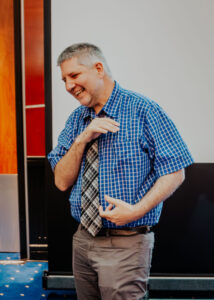
Michael McLellan is a co-founder of the British Columbia Self Advocate Leadership Network (BCSALN), and a board member of Inclusion BC. He lives in Nanaimo and lives with a disability. Michael started the British Columbia Self Advocate Leadership Network (BCSALN) in 2019 because, while there were organizations like Inclusion BC and the BC CEO Network
bringing together community living organizations, there was no umbrella organization for self-advocate groups. Michael says, “we believed that we needed a self-advocate network…and felt that there wasn’t that (Advocacy group) there unless somebody started it and here is an opportunity to connect.” So, BCSALN was founded by existing self-advocacy organizations BC People First, Mission Self Advocates (MSA), and Self-advocates of Semiahmoo (SAS). BCSALN became a registered non-profit society in 2022 and was the first self-advocacy organization to become a member of Inclusion BC.
When Covid started, BCSALN moved their meetings online, which meant they could meet more often. As the pandemic went on, BCSALN and others advocated for an updated Essential Visitors Policy in hospitals, which allowed family members and support staff to accompany people who needed communication assistance and supported decision-making. Before this update, people with disabilities were often not receiving the support they needed to make informed decisions about their care in hospital settings during the pandemic.
Self-advocacy groups are important to the disability rights movement because they create a path for people with disabilities to “learn to use their voice,” as Michael puts it. “We need organizations or groups because we are there to speak for lots of people with developmental disabilities [and can] network and work together. It is about the person’s journey and the organization.” Another project that BCSALN has developed is called Words Matter, which addresses the importance of the words we use and why some familiar words can feel disrespectful. Michael spoke a bit about one word he dislikes. “I can’t stand the word ‘client‘. We are all people just like you, I’m sorry, you don’t own me…we don’t want to be treated differently than everyone else.”
They’ve also been expanding their horizons and finding new collaborators: “One of the great partnerships we have is with the Canadian Institute for Inclusion and Citizenship. We got three great practicum students out of the Okanagan campus [where we] learned a lot from them and they learned a lot from us. It’s a bonus to have that partnership for us.”
Michael’s goals for BCSALN are to grow their membership, bring further awareness to the use of language, and work more with Indigenous communities. Michael explains that for BCSALN, supporters and allies are a key element of their success, but that the choice and control of the organization lies with self advocates.
Michael has some advice for service providers: “Let the self-advocates lead the way of your organization, help them grow a group that is going to be there to work with you, and let them have their voice outside your organization. Remember, you are just providing them with support.”
Ways to connect with and support BCSALN:
Visit BCSALN’s website: https://bcsaln.com/
Apply to be a member of BCSALN: SALN-Member-Application-01-22.pdf (selfadvocatenet.ca)
Donate: https://uniti4all.com/home/donations/
Written by Katie Miller and Galen Exo
This was posted on Inclusion BC website go to the link here


